How Professional Cleaners Handle Bathrooms

The bathroom is the room most people dread and the room most people clean wrong. It's small, it's wet, and every surface fights back in a different way — glass hazes over, grout darkens, the toilet hides grime in places you'd rather not think about, and Idaho's hard water leaves a chalky film on everything. Scrub in the wrong order with the wrong product and you end up doing the whole thing twice.
Professionals don't clean a bathroom harder than you do. They clean it in a deliberate order, they let their products do the chemical work instead of relying on elbow grease, and they treat different surfaces as different problems. There's a real method to it, and once you see it laid out, your own bathrooms get easier too.
This guide walks through exactly how a pro approaches a bathroom, step by step — the top-down order, dwell time, toilets, showers and glass, hard water, grout, mirrors, and floors. It also covers what separates a standard clean from a deep clean, the difference between sanitizing and disinfecting, and how we handle all of it chemical-free. We're a chemical-free house cleaning company based in Meridian, Idaho, and if you'd rather hand the whole room off, you can reach us at +1 877-754-5614.
In this article
- 1. The Two Rules Behind Every Professional Bathroom Clean
- 2. Step One: Clear, Dust, and Apply Product Early
- 3. Showers, Tubs, and Glass: The Hardest Surfaces
- 4. Toilets, Mirrors, Fixtures, and Floors
- 5. Grout, Mold, and Mildew
- 6. Standard Clean vs Deep Clean, and Sanitizing vs Disinfecting
- 7. Our Chemical-Free Approach to Bathrooms
The Two Rules Behind Every Professional Bathroom Clean
Almost everything a pro does in a bathroom comes back to two ideas. Get these two right and the rest is just execution.
The first is top to bottom. Cleaning a room stirs up dust, sprays droplets, and drips product. If you clean the floor first and then wipe the mirror, the drips and dust land on the floor you just finished. So pros always work from the highest surface down: vents and light fixtures, then mirrors and upper walls, then counters and fixtures, then the toilet, and the floor dead last. Gravity does the sorting, and nothing gets cleaned twice.
The second is dwell time. This is the single biggest difference between how a pro and a rushed homeowner clean. Cleaning products — whether they lift grime, dissolve mineral, or kill germs — need time sitting wet on a surface to work. A spray-and-immediate-wipe barely does anything. A pro applies product early, moves on to another task while it sits, then comes back once the chemistry has done the heavy lifting. The scrubbing that's left is easy, because the product already loosened the mess.
Step One: Clear, Dust, and Apply Product Early
Before any real cleaning starts, a pro clears the decks. Everything comes off the counter, out of the shower caddy, and off the toilet tank — because you can't clean a surface you can't reach. The trash gets emptied and any towels or bath mats get set aside.
Next comes the dry pass. Working top down, they knock cobwebs from ceiling corners, dust the exhaust vent, light fixtures, and the top of the mirror or medicine cabinet, then wipe down shelves and the tops of trim. Doing this dry, before anything gets wet, keeps dust from turning into a smeared paste later.
Then the key move: apply product early so it can dwell. This is where order and patience pay off. A pro sets the chemistry working on the toughest jobs first, then handles quicker tasks while those sit.
- Toilet bowl — cleaner goes in first thing so it can sit the longest.
- Shower and tub — walls, doors, and the tub get sprayed and left to soak while other surfaces are cleaned.
- Sink and counters — get product too, though these need less dwell time than the shower.
- Hard water spots — a mild acid goes on glass and fixtures early, because minerals need real contact time to dissolve.
Showers, Tubs, and Glass: The Hardest Surfaces
The shower is where most bathrooms are won or lost, and it's usually fighting two enemies at once. The first is soap scum — a sticky film that forms when soap reacts with the calcium and magnesium in hard water, then bonds to glass and tile. The second is the mineral scale from the hard water itself. Because both build up in layers, a quick wipe never reaches the bottom of them, which is why a shower can look cloudy no matter how often you spray it.
This is exactly why the product went on early. By the time a pro comes back to the shower, the treatment has softened both layers, so the glass and tile release their film with a gentle scrub instead of an arm-aching one. On glass, the finish matters as much as the scrub: a squeegee or a dry microfiber buff pulls the last of the loosened mineral off so it dries clear instead of hazy. In Idaho, where the water runs very hard, this step is the difference between a shower door that sparkles and one that looks foggy an hour later.
Tubs get the same treatment — a soak, a scrub along the waterline where the ring forms, and attention to the corners and the caulk line where moisture collects. Shower heads clogged with mineral get a longer soak so the nozzles run freely again.
Toilets, Mirrors, Fixtures, and Floors
With the shower soaking, a pro moves through the rest of the room in order. Because the toilet bowl cleaner has had the longest dwell time, it scrubs out easily now. The bowl gets brushed under the rim and down through the trap, then — and this is the part homeowners skip — the entire outside gets wiped and dried: the tank, the lid, the seat, the hinges, the base, and the floor right around it, which is where the worst grime hides.
Mirrors and glass are done with a barely-damp cloth and a dry buff, working top down so no drips streak the finished surface. Fixtures — faucets, handles, towel bars, and the toilet flush lever — get cleaned and, importantly, dried, because in hard-water country a wet fixture spots as soon as it dries. Sinks and counters come next: scrub the basin, clear the drain and overflow holes, wipe the faucet base where scale crusts up, and dry it all down.
The floor is always last. Everything above it has been cleaned, so any final dust or droplets have already fallen. A pro sweeps or vacuums first to lift hair and grit, then mops — paying real attention to the corners, the baseboards, and the tight space behind the toilet where dust and grime collect. Cleaning the floor before the rest of the room would only mean cleaning it again.
Grout, Mold, and Mildew
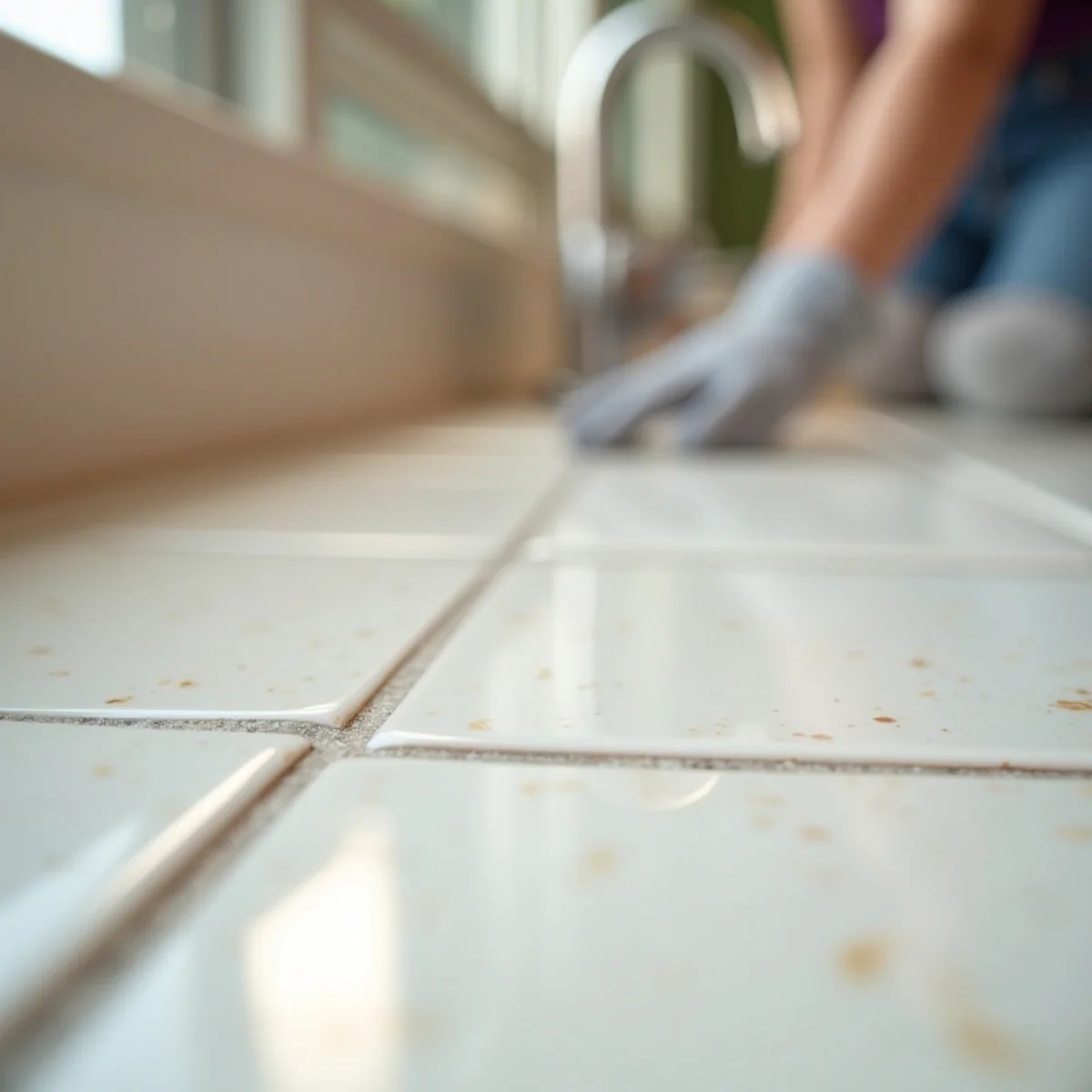
Grout is the detail that makes a tiled bathroom look either fresh or tired. Because it's porous and sits slightly recessed, it traps soap, mineral, and moisture, and it darkens over time. Everyday mopping glides right over it. Restoring grout means working the lines directly — a stiff brush, a suitable cleaner, and dwell time to lift what's settled in. When buildup runs deep or the color has genuinely shifted, that's a job for dedicated tile and grout cleaning, which reaches the recessed lines a routine clean can't.
Bathrooms also grow things, and it helps to know what you're looking at. Mildew is the flat, powdery, gray-to-white film that spreads across grout, caulk, and windowsills — it lives on the surface and wipes away with the right cleaner and a little effort. Mold is different: it's often raised, fuzzy, or slimy, and can be green, black, or other colors. Mold penetrates below the surface, tends to return quickly even after you wipe it, and points to a moisture problem worth addressing. A quick test — if a light film wipes off and stays gone, it was mildew; if it stains, feels raised, or comes back fast, treat it as mold.
In Idaho's climate the bigger driver is usually humidity with nowhere to go. A few habits keep both at bay:
- Run the exhaust fan during every shower and for 15 to 20 minutes after, so moisture leaves instead of settling.
- Squeegee the glass and walls after showering to cut the water that feeds mildew.
- Keep the caulk and grout sealed — cracked, unsealed lines soak up water and grow film fast.
- Deal with light mildew early on grout and caulk before it establishes and stains.
- Address persistent mold at the source — if it keeps returning, the fix is ventilation and a leak check, not more scrubbing.
Standard Clean vs Deep Clean, and Sanitizing vs Disinfecting
Not every bathroom clean is the same job, and knowing the difference helps you book the right one. A standard clean is maintenance: mirrors, the outside and bowl of the toilet, sinks and counters, a wipe of the shower and tub, and the floor. It keeps a bathroom that's already in good shape looking that way, and it's the backbone of a standard cleaning or a recurring visit.
A deep clean goes after everything that builds up over weeks and months. It's where the grout gets scrubbed by hand, the shower glass and tile get de-scaled, the shower head gets descaled, soap scum comes off the walls, hard water is stripped from fixtures, and the toilet gets cleaned all the way around and behind. If a bathroom hasn't had a thorough reset in a while — or you're moving in or out — a deep cleaning is the one that makes the visible difference. Many Idaho homes we work with start with a deep clean to strip months of mineral and soap scum, then stay easy with recurring visits.
One more distinction worth knowing: sanitizing reduces germs to a safer level, while disinfecting kills a broader range of bacteria and viruses. Bathrooms — especially toilets, handles, and flush levers — are where disinfecting matters most. The critical rule either way is that you have to *clean first*: dirt and film physically block a disinfectant from reaching germs, so a surface that isn't clean can't truly be disinfected, no matter what you spray on it.
Our Chemical-Free Approach to Bathrooms
A bathroom is the last place you want a cloud of harsh fumes — it's a small, poorly ventilated room where you and your family breathe deeply in the shower. That's the whole case for how we work. Sophisticated Cleaners is a chemical-free house cleaning company, and bathrooms are where the approach proves itself. You don't need caustic products to strip soap scum or dissolve Idaho's hard water; you need the right mild-acid treatment, the right dwell time, and the technique to know which surface takes which method.
That means we treat hard water build-up on glass, fixtures, and the toilet waterline as a standard part of the clean rather than a surprise add-on, and we handle grout and mildew where they've taken hold. Because we clean across Meridian, Boise, and Nampa, we know exactly what the local water does to a bathroom and how to stay ahead of it.
If your shower glass has gone foggy no matter what you spray, or the grout has darkened past the point a mop can fix, that's not a lost cause — it's the right job done the right way. Call +1 877-754-5614 or request a free quote, and we'll get your bathroom genuinely clean, chemical-free.
Want it done for you?
Chemical-free house cleaning across Idaho. Free quotes, no obligation.